Warrior-in-Waiting by Farman Edward George & Farman E.G
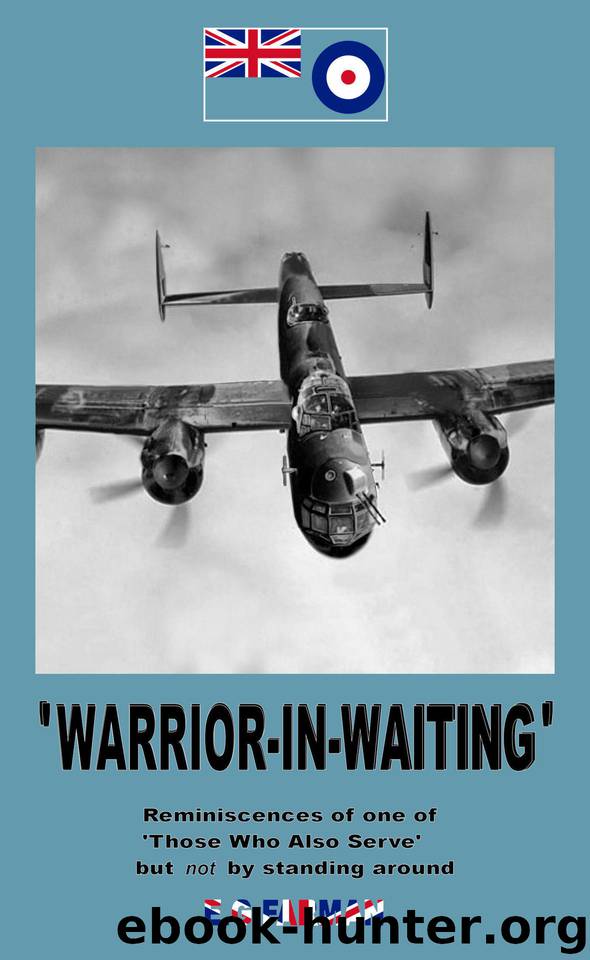
Author:Farman, Edward George & Farman, E.G [Farman, Edward George]
Language: eng
Format: epub
Publisher: Andy Farman
Published: 2019-06-17T16:00:00+00:00
RAF Tangmere
No.115 Squadron
18 May 1960 to 24 May 1962
No. 115 Squadron was a busy unit, charged as it was with calibrating the approach and landing aids for all RAF stations and staging posts from the UK to Cyprus. The general feeling was correspondently brisk and businesslike, and the mix of officer and NCO aircrew blended smoothly, as at Lindholme.
I started flying on 23 May, with the day acceptance check, on the 24th flew a calibration detail which needed no special expertise from me, and then the night acceptance check. Two more days were taken up with on-the-job dual instruction in calibrating the Instrument Landing System (ILS), then I was off and running on my own.
There was a Canberra squadron which shared the airfield, No.245 I think, tasked with calibration of the area navigation systems and air-defence radar, and the long-range approach aids used in recovering fighters to base. At one period they, and specially selected crews from 115, also kept up a special patrol to pick up the rapid bursts of information that were transmitted by a Russian spy cell, active in the London area. They were successful in pinpointing the source closely enough for the spies to be caught, tried and sentenced.
A flight of search-and –rescue Whirlwind helicopters was also based at Tangmere.
Servicing of both squadrons was contracted out to the firm of Short Brothers. The only RAF groundcrew involved with the flying were technicians who formed part of the crew for ILS tasks: about half of these technical specialists were civil servants.
The types of equipment which we calibrated were: Ground Controlled Approach (GCA), with which a ground-based controller talked the pilot down the landing approach path; ILS, which provides the pilot with visual guidance by way of two moving needles, vertical and horizontal; Eureka 7, a British approach and landing system, and its US-developed rival, Tacan, which became the NATO standard for fighter airfields. There were also up-dated versions of the old BABS dot-and-dash beacon system, as well as the airfield control radars that gave air traffic controllers a continuous picture of traffic in the local area and were used for landing guidance, and the cathode-ray direction finders which gave an instantaneous bearing on each transmission from an aircraft. All had to be tested and corrected for errors, periodically and after repairs or major servicing.
The minimum flight crew consisted of pilot, navigator and, in place of the flight engineer who could occupy the right-hand seat at Lindholme, a signaller. For ILS tasks we carried two signallers, the other to operate the sensitive recording equipment at the rear of the cabin, where it was least likely to suffer interference from the engine ignition systems.
We would begin an ILS job by landing to put the navigator, who carried a balloon theodolite, and the technician with his tools and instruments, as close as we could to the ILS hut, near the touch-down end of the runway. While they set up the theodolite we would take off and position for the first run.
Download
This site does not store any files on its server. We only index and link to content provided by other sites. Please contact the content providers to delete copyright contents if any and email us, we'll remove relevant links or contents immediately.
Waking Up in Heaven: A True Story of Brokenness, Heaven, and Life Again by McVea Crystal & Tresniowski Alex(37811)
Empire of the Sikhs by Patwant Singh(23086)
We're Going to Need More Wine by Gabrielle Union(19046)
Hans Sturm: A Soldier's Odyssey on the Eastern Front by Gordon Williamson(18592)
Leonardo da Vinci by Walter Isaacson(13336)
The Radium Girls by Kate Moore(12028)
Tools of Titans by Timothy Ferriss(8396)
Educated by Tara Westover(8054)
How to Be a Bawse: A Guide to Conquering Life by Lilly Singh(7486)
Permanent Record by Edward Snowden(5847)
The Last Black Unicorn by Tiffany Haddish(5636)
The Rise and Fall of Senator Joe McCarthy by James Cross Giblin(5280)
Promise Me, Dad by Joe Biden(5153)
The Wind in My Hair by Masih Alinejad(5095)
A Higher Loyalty: Truth, Lies, and Leadership by James Comey(4964)
The Crown by Robert Lacey(4817)
The Iron Duke by The Iron Duke(4356)
Joan of Arc by Mary Gordon(4112)
Stalin by Stephen Kotkin(3966)
